

Stablecoins Hotspot Research: My 2021 Data vs the 2026 Reality
By Oluwashina Peter / Research, Growth & Web3 Ecosystems
In 2021, I ran a global research study on stablecoins adoption across 20 countries for Celo. One question drove it: where in the world are people most likely to embrace a digital dollar, and why?
I mapped on-chain data, Google Trends, P2P exchange volumes, and the macro signals that tend to predict demand — inflation, currency controls, remittance flows, smartphone penetration — across every major region. The output was a ranked list of hotspots. The top five everyday-user markets were 🇳🇬 Nigeria · 🇻🇪 Venezuela · 🇦🇷 Argentina · 🇹🇷 Turkey · 🇺🇦 Ukraine. Not because any of them loved crypto. Because their currencies were failing them.
Five years on, with the total stablecoin market having grown from roughly $120 billion to over $320 billion, I went back to that research to ask a simple question: what held up? Here’s how the data looks, region by region and then a hard look at which specific coins actually won.
Africa
2021: USDT dominated P2P trading, but no single coin had locked down the continent yet. I flagged Nigeria as the highest-P2P-volume market in the world, with no clear winner — an open field.
2026: Nigeria has become one of the most important stablecoin markets on earth. It received roughly $92.1 billion in on-chain crypto value in the year to June 2025 — nearly triple South Africa, the second-largest African market — and ranks sixth globally for grassroots adoption. On platforms like Yellow Card, USDT now commands about 88.5% of transaction share, with USDC the rising compliance alternative at around 10%. Sub-Saharan Africa now leads the world with a 9.3% adoption rate, and stablecoins make up roughly 43% of the region’s crypto transaction volume. The call aged well — and the “macro pain” reading proved exact: when the naira devalued sharply in early 2025, Nigerian on-chain volume spiked while most other regions were contracting.
Latin America
2021: USDT was the inflation escape hatch. DAI was a niche tool — beloved by DeFi-savvy Argentines as a “digital dólar,” but not yet mainstream.
2026: The inflation thesis is confirmed, emphatically. USDT and USDC together now make up more than 90% of exchange volume in the region, up from roughly 60% in 2022. In Argentina, stablecoins accounted for 72% of all crypto purchases in 2024 — Bitcoin trailed at just 8%. And Venezuela became the clearest proof of the framework: about 90% of all listings in Binance’s most popular P2P order book are now denominated in USDT, the country runs a roughly $44.6 billion annual crypto economy, and the state oil company reportedly settles around 80% of its crude revenue some $12 billion a year, in Tether. When a currency dies, stablecoins don’t just trade. They become the economy.
Southeast Asia
2021: USDT-led, moving through P2P channels and remittance corridors. I underweighted the Philippines, and barely registered Vietnam and Indonesia.
2026: All three sit among the most active crypto markets in the world, driven by remittance flows, play-to-earn gaming, and increasingly stablecoin payments. This is the region where I had the data in front of me and simply didn’t read it aggressively enough. The signal was there in the search volumes and the remittance dependency — I just didn’t weight it the way the macro picture deserved.
Europe & Euro Stablecoins
2021: I predicted euro-backed stablecoins would struggle — negative interest rates, thin exchange listings, low awareness. There was no economic pain forcing adoption, so I expected little to happen.
2026: For years, exactly that — nothing. Then the EU’s MiCA regulation took effect in June 2024 and the euro market roughly doubled within twelve months to around $680 million, led by Circle’s EURC (now ~41–49% of euro supply) and a 644% surge in Stasis’s EURS. But the scale check is brutal: that entire euro market is under $700 million against USDT’s ~$187 billion. Over 99% of all stablecoin supply is still USD-pegged. Europe is the exception that proves the rule — it took a regulatory event, not an economic one, to move the market at all, and even then the dollar’s dominance barely flinched.
The coins themselves: who won, who died
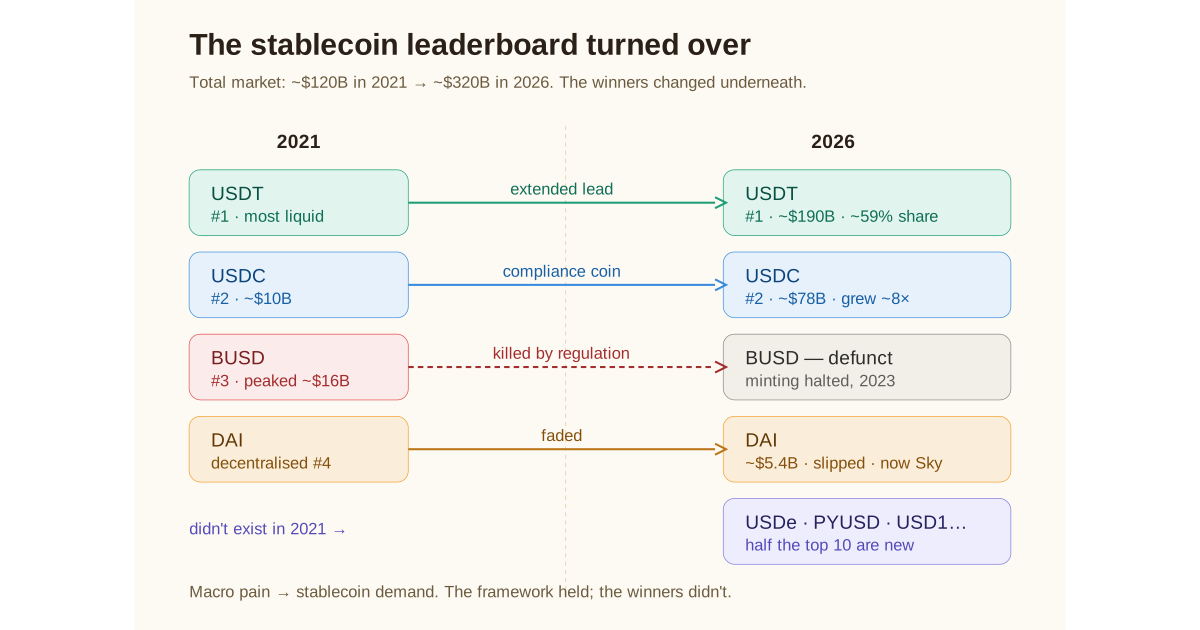
The regional story was about geography. But the most surprising finding when I went back was about the coins. In 2021, I profiled four clear leaders. Five years later, their fates split four different ways.
USDT didn’t just survive — it consolidated. From the leader in 2021 to roughly $190 billion and about 59% of the entire market in 2026. The first-mover advantage I flagged didn’t decay; it compounded. During the DeFi turbulence of early 2026, capital fled toward USDT, not away from it — in a crisis, traders ran to the deepest liquidity. Trust beat transparency.
USDC grew roughly eightfold but stayed firmly second. It became exactly what I called it in 2021 — the institutions’ coin — and new US regulation sharpened that identity. It reached about $78 billion, with supply up over 220% since late 2023. Still less than half of USDT’s size. Being the cleaner option is not the same as being the bigger one.
BUSD — the name I’d have least expected to vanish — is gone. It peaked above $16 billion as the #3 stablecoin. Then in February 2023, New York’s regulator ordered its issuer to stop minting it, and it has bled toward zero since. This is what my 2021 research most underweighted: a stablecoin’s biggest risk often isn’t its peg or its reserves — it’s a regulator’s signature.
DAI survived but slipped. Still here, still decentralised, but now around fourth at roughly $5.4 billion — overtaken by coins that didn’t exist when I wrote the report. Its issuer rebranded to Sky and launched a successor token (USDS). The decentralised dream held; it just didn’t scale like the centralised dollars.
And the most telling fact of all: roughly half of today’s top ten stablecoins weren’t on anyone’s radar in 2021 — Ethena’s USDe, PayPal’s PYUSD, the Trump-linked USD1, Paxos’s USDG, and Ripple’s RLUSD. Meanwhile, the algorithmic category I’d marked as “one to watch” was effectively wiped out: Terra/LUNA destroyed an estimated $40–60 billion in May 2022, and algorithmic coins now make up under 3% of the market.
The 2021 top 4, five years on
| Coin | 2021 status | 2026 status | Outcome |
|---|---|---|---|
| USDT | The leader; most liquid | ~$190B, ~59% share | Extended its lead |
| USDC | ~$10B; Visa deal | ~$78B, clear #2 | Grew ~8× |
| BUSD | #3 giant, ~$16B | Defunct since 2023 | Killed by regulation |
| DAI | Decentralised darling | ~$5.4B; now Sky | Slipped down |
The signal that called it everywhere
Across every region, one variable predicted adoption in 2021 — and still predicts it in 2026: macroeconomic pain.
- USDT took the flight-from-fiat markets — Nigeria, Venezuela, Argentina, Turkey.
- USDC took compliance — institutions, regulated rails, the post-MiCA and post-GENIUS-Act world.
- DAI took DeFi — the decentralised, on-chain niche.
- Algorithmic stablecoins took themselves out — trust never recovered after Terra.
The engine was never crypto enthusiasm. It was people fleeing weak fiat, looking for a dollar they could actually hold.
That framework worked in 2021. It still works in 2026. The structural trend — USD stablecoins becoming the default financial infrastructure for stressed economies — was overwhelmingly right. But betting on any specific coin to stay on top was close to a coin flip: of the four 2021 leaders, one doubled down, one grew eightfold, one was killed by regulators, and one quietly faded.
If you want to know where stablecoins grow next, the signal hasn’t changed. Don’t look at the crypto-native indicators. Look at where the local currency is failing.
Which region’s story surprised you most — or was it a coin?
◆ ◆ ◆
If you’re building in stablecoins, payments, or DeFi — particularly in emerging markets — I’d love to connect. I’ve spent years at the intersection of research, growth, and Web3 ecosystems.