
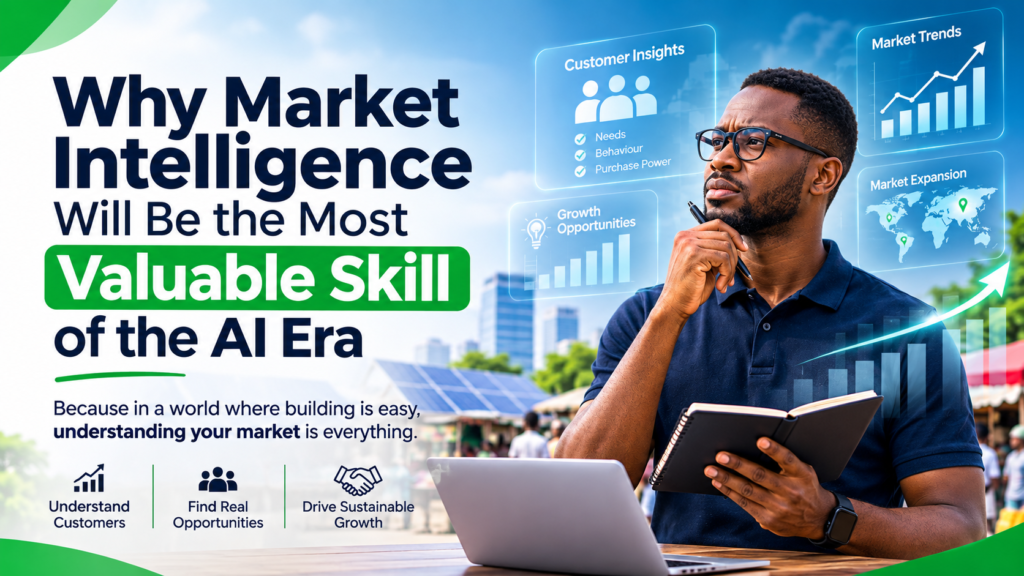
AI has made building products incredibly easy.
At Gateway App, shipping a new version used to take us weeks, sometimes months. Recently, I built a game for my daughter in two hours and a crypto wallet in two days to start her college fund.
The barrier to taking an idea from concept to product has never been lower.
But there’s a problem: building something doesn’t mean people need it, will use it or will pay for it.
As AI makes product development cheaper and faster, I believe the real competitive advantage will shift towards understanding markets. Market intelligence will become one of the most valuable skills in the AI era.
What do customers actually need? How do they solve the problem today? Who do they buy from? What do they pay? What frustrates them about existing solutions?
These are the questions that determine whether you have a business or just another product.
The emerging role of market intelligence
After publishing a post about the Nigeria to China payments corridor, five founders reached out to me. They were building products for this market but faced a similar challenge: they needed to understand their customers better.
They wanted data. They wanted to speak to merchants, understand existing payment flows and identify gaps in the market. But they didn’t have the time, people or local presence to do this at scale.
This got me thinking about how the role of market research is evolving.
Traditionally, understanding customers was largely associated with UX researchers, analysts and consulting firms. But I think we’re moving towards something more commercially integrated.
We need people who can go into the market, speak to customers, gather intelligence, understand the competition, identify opportunities and translate those insights into revenue.
People with analytical minds, sales ability and marketing instincts.
AI can analyse thousands of data points, identify patterns and generate reports. But someone still has to go out there and collect reliable data. Someone has to build relationships, ask the right questions and understand the context behind the answers.
Human behaviour is best understood up close.
I believe we’ll see more dedicated Market Intelligence roles, particularly in emerging markets where reliable, on-the-ground customer information is difficult to obtain.
A case study: Understanding the Nigeria to China payments corridor
Cross-border payments have been a problem in African markets for as long as I’ve been online.
I recently saw someone on X mention that he’d come across more than 100 startups building cross-border payment solutions and questioned why so many teams were tackling the same problem.
My response was simple: the market still lacks the end-to-end solution customers actually need.
The difficult parts aren’t necessarily building another payment interface. They’re compliance, FX, treasury management and last-mile settlement.
I’ve been particularly interested in the Nigeria to China corridor, which is estimated to handle around $20 billion in annual trade.
To understand this market, I decided to start with the solar industry. Nigerian solar businesses import a significant portion of their equipment from China, making them an interesting segment for understanding how money moves between both countries.
I built Kostomer, a customer management platform for solar businesses.
Then, together with a small team of field agents, we went into the market to sell the software and, just as importantly, understand how these businesses operate.
We attended the Nigeria Energy conference and engaged directly with solar businesses.
We wanted answers to practical questions:
- Where do these businesses source their products?
- How do they pay their Chinese suppliers?
- Which platforms, agents and channels do they use?
- What exchange rates and transaction fees do they pay?
- How long does settlement take?
- What problems do they encounter with existing providers?
- What would make them switch to a better solution?
The exercise gave us a much clearer picture of the market and its existing payment infrastructure.
I’ll share some of the findings and data in a separate post.
Beyond that, I advised a Layer 1 blockchain exploring opportunities in this market. I helped map the settlement flow, identify relevant partners and licensing requirements, and understand how merchants currently make payments.
We also built a list of merchants processing millions of dollars in annual transactions who have expressed interest in switching to a better payment provider.
What started as an exercise to understand the customers of a solar CRM product became an opportunity to uncover a much bigger financial infrastructure problem.
That’s the value of market intelligence.
The next competitive advantage
My background is in product, growth and marketing. But this experience has put me in a slightly different role.
I’m increasingly spending my time understanding markets, mapping customer behaviour, identifying commercial opportunities and helping businesses figure out how to enter new markets.
I think this will become a distinct professional function: Market Intelligence Officer.
Today, much of this work sits under titles like Business Development Lead, Growth Lead, Strategy Lead or Country Manager.
But I believe there’s room for a dedicated role that combines research, field intelligence, sales, market entry strategy and commercial execution.
This is particularly relevant to companies entering emerging markets. You can have excellent technology, funding and a great product, but without understanding how people actually do business, you’re making expensive assumptions.
AI will make it easier to build almost anything.
Understanding what to build, who needs it, how to reach them and why they’ll pay for it will be a different challenge.
And I think the people who can bridge that gap will become increasingly valuable.
I’m currently open to full-time opportunities and consulting engagements with teams exploring or entering African markets, particularly across fintech, stablecoins, cross-border payments and energy.
If you’re building in these sectors and need someone who can get close to the market, understand the customers and turn those insights into commercial opportunities, let’s talk.